Organisations
An organisation is an independent Kanera space with its own people, roles, workspaces, standalone boards, settings, plan, billing, and storage. One user account can belong to several organisations, so you do not need a separate login for each team, company, client, community, or personal space.
Only one organisation is active in the main Kanera shell at a time. Switching changes the work and administration settings shown in the sidebar. Global Work can still bring together cards from every organisation and guest board your account can access.
Switch organisations
Open your user menu at the bottom of the sidebar. The Organisations section lists every active organisation membership for your account. The check marks the active organisation, and unread counts show where notifications are waiting.

Select another organisation to switch to it. Kanera reloads the shell with that organisation's work, permissions, plan, settings, and sidebar preferences.
Your role can differ between organisations. For example, you can own a personal organisation, be an admin in one team, and be a member in another.
Create another organisation
- Open your user menu.
- Select Create organisation.
- Enter the organisation name.
- Select Create organisation.
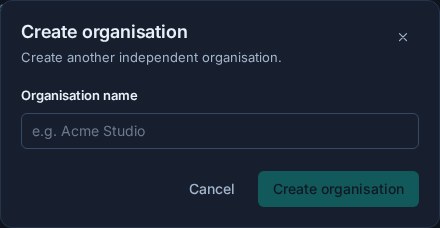
Kanera creates an independent organisation, makes you its owner, switches to it, and opens onboarding. Choose a standalone board or workspace to create its first work, or select Skip for now to continue to an empty Home and decide later.
On Kanera Cloud, each organisation has its own plan and billing. On a self-hosted installation, the organisation is still an independent access and administration boundary even though the operator controls the deployment.
Join an organisation
An organisation admin creates an invitation from Profile settings -> Users. The invitation sets your organisation role and can grant access to selected workspaces. It can be given an expiry date and revoked before acceptance.
If you receive an invitation link:
- Open the link and sign in with your existing Kanera account, or create an account if you do not have one.
- Review the organisation name and role.
- Select Join.
You can also join from inside Kanera:
- Open your user menu.
- Select Join organisation.
- Paste the full invitation link or its invite token.
- Select Continue, review the invitation, and accept it.
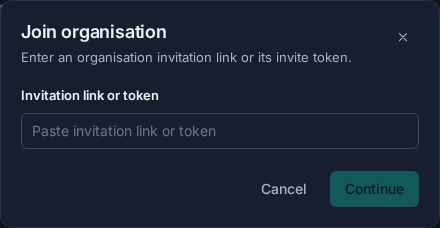
Accepting an invitation keeps your existing identity and other organisation memberships. Kanera switches to the organisation you just joined. The invitation must be active, use an available seat where the plan requires one, and match the invited email address when an email restriction is present.
Invite someone as a member
Organisation owners and admins can create membership invitations from Profile settings -> Users:
- Choose the organisation role: Member or Admin.
- Select at least one workspace and choose the person's role in each one.
- Choose when the invitation expires.
- Create and copy the invitation link.
The recipient can accept with an existing Kanera account even when that account already belongs to another organisation. Membership is different from guest access: a member joins the organisation and can receive workspace membership, while a guest remains external and can access only explicitly granted boards.
Understand the boundaries
| Setting or resource | Scope |
|---|---|
| Organisation role | Separate for each organisation membership. |
| Workspaces and standalone boards | Owned by one organisation. |
| Plan, billing, seats, and storage | Managed per organisation on Kanera Cloud. |
| Organisation settings and users | Apply only to the active organisation. |
| Sidebar layout preferences | Remembered separately for each organisation. |
| Profile, password, and authenticator | Belong to your user identity and follow you across memberships. |
| Global Work | Can show permitted work across organisations and guest boards. |
Removing someone from one organisation removes their access to that organisation's work. It does not delete their identity or remove their memberships in other organisations.
Set the board-health default
Organisation owners and admins can open Profile settings -> Organisation -> New workspace defaults and enable or disable Show board health by default.
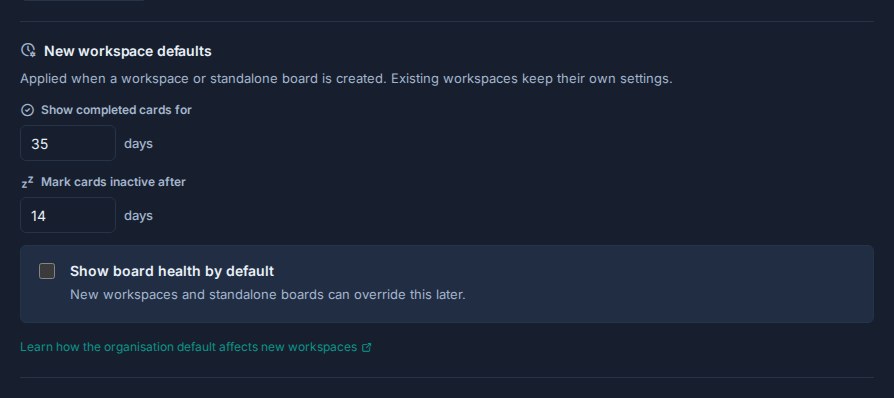
The choice is copied only when a workspace or standalone board is created. It does not update existing workspaces. Each workspace can override the enabled state and choose its own Overdue, Unassigned, and Inactive signals later. See Board Health for the exact scope and calculation.